Hybrid Learning Grants are for redesigning an existing course or designing a new course with already-defined learning outcomes, materials and schedule. This grant program leverages the strengths of online and in-person learning modalities to create engaging, interactive and flexible learning environments.
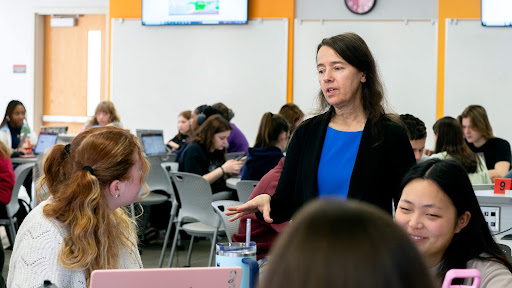
Hybrid learning courses often adopt the flipped classroom approach by moving in-class lecture-based direct instructions to asynchronous online learning, while allocating most class time for active learning and problem solving to apply the newly learned knowledge and skills, as well as preparing students for transfer problem solving after class with increased independence.
The emphasis on knowledge/skill application and real-world problem-solving through social interactions with peers and the instructor supports the Packways: Learning by Doing QEP plan by providing high-impact experiences at the course level, which can get students ready for professional, scholarly, community or global engagement beyond the classroom.
With the advent of Generative AI, Hybrid Learning Grants utilize custom AI assistants to support the course design process, as well as partnering with instructors to create AI-supported activities or AI assistants to enhance student learning in their own courses. This grant type involves the first year of designing and developing the course and the second year of assessing the impact of course design on learning outcomes and student perceptions.
“The DELTA Hybrid Learning Grant was essential to the redesign process of my course. It is a highly structured and well-thought-out sequence of milestones designed to guide you through the redesign process.
Dr. Bruce Branson
Professor of Accounting Instructor of ACC 210: Concepts of Financial Reporting Department of Accounting, Poole College of Management 2024-2025 DELTA Grant Recipient
Your existing or new course is a credit-bearing course at NC State University.
You will be teaching the proposed course as an on-campus section in fall 2027 and/or spring 2028.
You intend to use the majority of class time for guided active learning with student-to-student and student-to-instructor interactions, while moving lecture learning online before in-person class.
You want DELTA support to assess the effectiveness of your course design.
Award
$8,000 stipend
Course design cohort with interdisciplinary interactions
Individual mentoring
Media design support (if resources available)
Services Provided
Bi-weekly one-hour cohort sessions (usually on Fridays 9-10 a.m.) led by a DELTA instructional designer to learn about design strategies/examples and how to use custom AI assistants for course design, as well as interacting with peer instructors (first year only).
Bi-weekly one-hour mentoring sessions with a course mentor to discuss course-specific design tasks, ideas, strategies, and feedback (first year only).
Custom AI assistants trained with pedagogical theories and previous course examples to support course analysis, design, and development.
Instructional media design and development support for creating media deliverables that can benefit hybrid learning (if resources are available, first year only).
Structured evaluation planning, data collection, and data analysis support during the first year (existing courses) and second year (all courses) to assess the impact of course design on learning outcomes as well as student perceptions and experience.
Length and Delivery
The Hybrid Learning Grants run for two years, with time commitment only required for the first year.
The first year begins fall semester and continues through the end of summer semester (12 months).
You will complete the course design and development within the first year, along with course design cohort, individual mentoring, and media design support (if resources available).
If you teach the proposed course during the first year, we will help you collect baseline assessment data for one semester.
The second year involves one or two regular semesters (Spring/Fall) of implementing the course. We will help you collect assessment data for one semester as you teach.
You will work with DELTA staff to collect data from student surveys and course grades.
DELTA will provide data analysis and reporting services for selected courses based on the assessment levels assigned when awarding the grants.
You have opportunities to prepare for presentations or publications to share your teaching experience and assessment findings.
Grant Expectations
Participate and successfully complete the “Applying the Quality Matters Rubric” workshop before the grant starts.
Attend a one-hour cohort session and a one-hour mentoring session every two weeks from late August to May during the first year.
Commit two to three hours per week working on the course design tasks before and after cohort/mentoring sessions. Finish course development by the end of the first year.
Keep up with the scheduled course design milestones and tasks during the first year. Showcase your course design prototype within the cohort around mid-December, and showcase your course design product to instructors from the upcoming cohort at the end of July.
If media design and development is needed and we have resources available, attend media discussion sessions in addition to the cohort/mentoring sessions and complete assigned tasks. Meeting time and workload depend on the media deliverable types and scope.
Teach the (re)designed course at least once in fall 2027 and/or spring 2028 and at least two times thereafter, with a minimum of three times total.
Work with DELTA to collect assessment data during one pre-redesign semester (existing courses) and one post-(re)design semester (all courses).
Share your course design and assessment findings with your field of teaching through presentations and/or publications inside or outside of NC State.
Competitive Priorities
Priority consideration is given to applications that:
Meet overall competitive priorities of DELTA Grants: